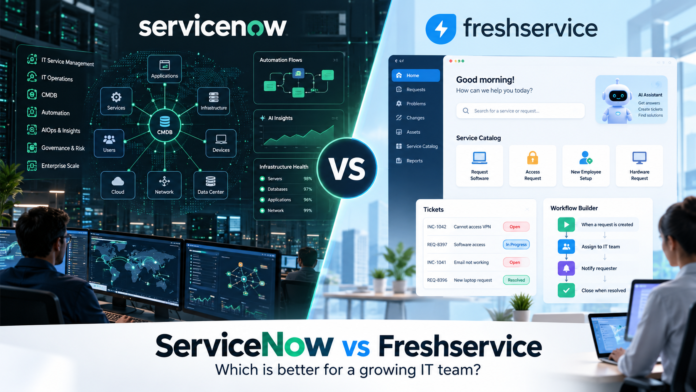

I ran incident management, change requests, and a service catalog through both ServiceNow and Freshservice for several weeks, using a 150-employee company as my test case. Both platforms claim they can handle IT service management for a growing company, but only one actually feels built for that size.
ServiceNow is the platform most enterprise IT leaders recognize for good reason. It runs incident management at banks, hospitals, and airlines, with a configuration management database (CMDB) that can map dependencies across thousands of assets. But nothing about ServiceNow is designed to be configured by one or two IT generalists on a Tuesday afternoon.
Meanwhile, Freshservice takes the opposite approach. I had a working service catalog and SLA policies live within a day, no professional services engagement required. It won’t match ServiceNow’s ceiling for a Fortune 500 rollout, but for a team without a dedicated platform admin, that ceiling hardly matters for day-to-day use.
Here’s what I found testing both, including where the pricing gap is bigger than it looks and what the tradeoff looks like in terms of limitations vs complexity.
ServiceNow vs Freshservice: At a glance
| ServiceNow | Freshservice | |
| Best for | Large enterprises (5,000+ employees) needing cross-departmental workflow orchestration. | IT teams at companies of 100 to 5,000 employees that want ITIL-aligned service management without lots of overhead. |
| Starting price | Custom quotes only | $19 per agent/month, billed annually |
| Key features | Native CMDB with Discovery and Service Mapping, Flow Designer workflow orchestration, cross-department modules | No-code Workflow Automator, Freddy AI Copilot and AI Agent, unified ITAM and ESM on the same platform |
| Pros | Unmatched configuration depth Scales to any enterprise workflow Extensive integration ecosystem | Faster implementationTransparent pricing More intuitive interface |
| Cons | Custom pricing with no transparency Steep learning curve Implementation runs six figures | Advanced reporting and scripted workflows are limitedAsset Unit packs, Business Agent licenses, and AI add-ons raise licensing costs |
ServiceNow
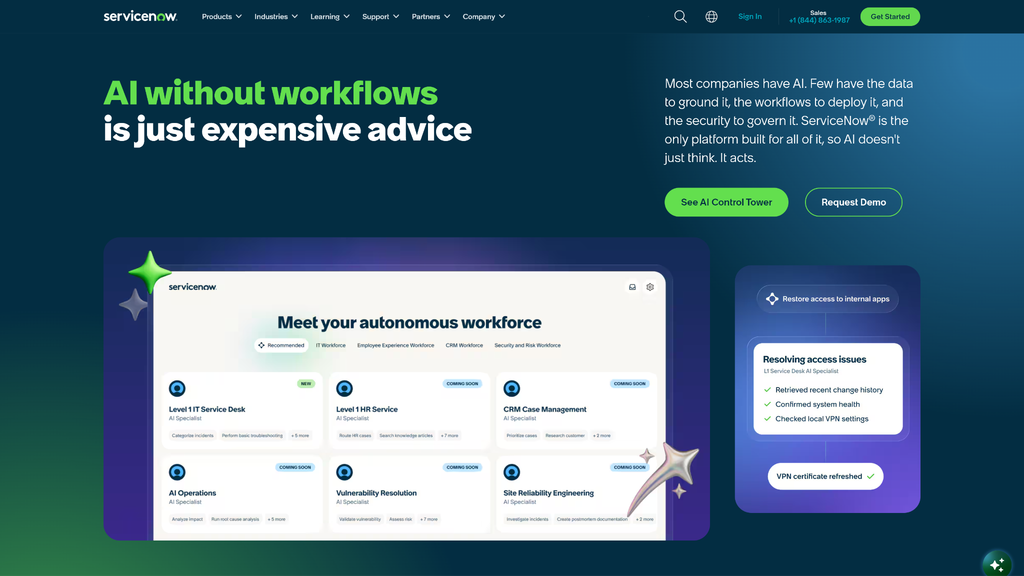
ServiceNow didn’t win over enterprise IT departments by accident. Every process I built during testing, from a basic incident to a multi-approver change request, sat on top of the same database and could be traced back to a specific configuration item. Traceability is the entire point of the platform, and given that data model, I could see why regulated industries lean on it so heavily.
But the tradeoff showed up immediately in setup time. Building even a modest workflow meant learning Flow Designer’s logic. Anything beyond the out-of-the-box templates pointed me toward hiring a certified ServiceNow developer. For a lean IT team, that’s a lot of friction before the tool does any actual work.
1. CMDB depth no other tool here matches
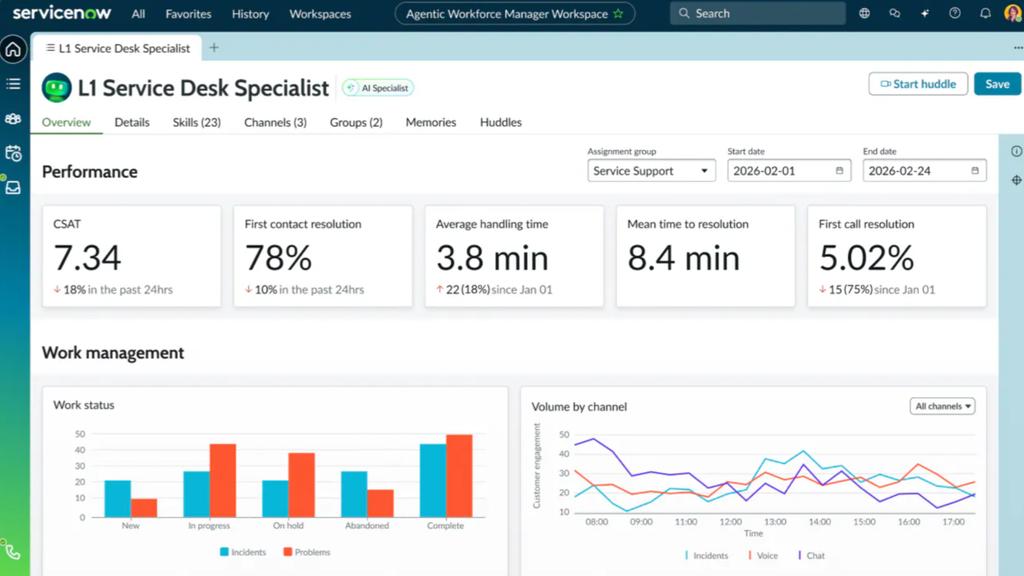
ServiceNow’s CMDB uses the Common Service Data Model to map every configuration item and its relationships, then layers Discovery and Service Mapping on top to keep that data current automatically. I could trace an incident straight to the server, application, and business service it touched for root-cause analysis. Most smaller IT teams will use a fraction of this capability, but if your environment is sprawling and multi-cloud, nothing else on this list matches it.
2. Cross-departmental workflow orchestration
Once I built a workflow in ServiceNow, extending it to human resources or customer service management meant reusing the same data model rather than starting over. This is part of what large enterprises are actually paying for — one centralized platform instead of five disconnected point solutions across IT, HR, legal, and security operations.
3. AI can scale with enterprise ticket volume
Now Assist, ServiceNow’s generative AI layer, handles predictive categorization and autonomous resolution at a scale that’s impractical to stress-test with just 150 employees. It’s also metered by consumption, which means cost tracks usage rather than seat count. ServiceNow’s December 2025 acquisition of Moveworks even adds conversational AI on top. For a service desk fielding tens of thousands of monthly tickets, that offers a lot of scalability which won’t matter for a smaller team.
Freshservice
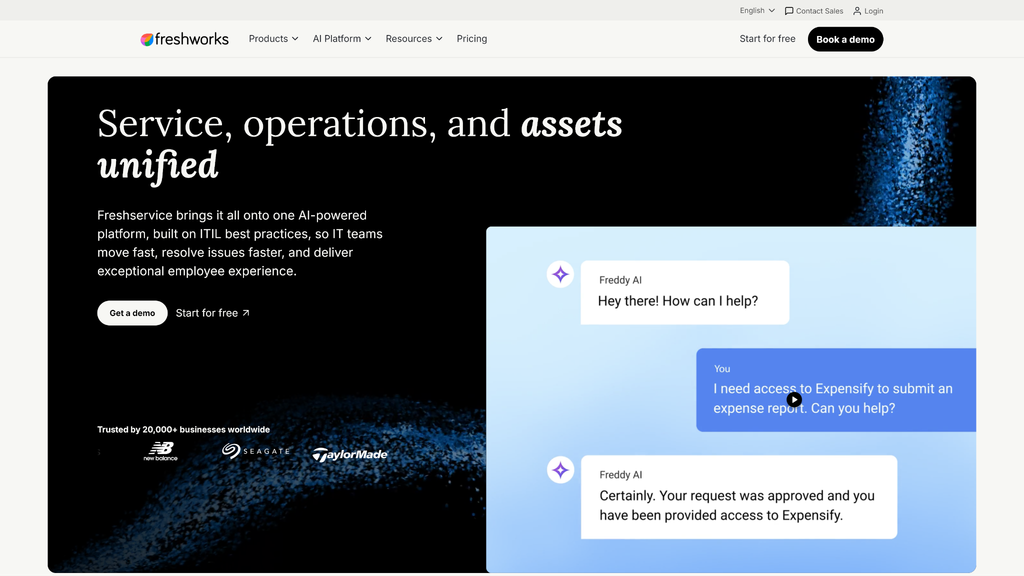
Freshservice felt built for exactly the team I tested it with. I had incident management, a self-service portal, and a basic service catalog before lunch. Its interface didn’t once make me feel like I needed a manual. That’s not a small thing when the person running your service desk is also handling three other jobs.
Freshservice’s Workflow Automator uses a drag-and-drop builder that covers most standard ITIL processes without a single line of code. Even when I hit a limit, support walked me through a fix over a call rather than pointing me to a partner network.
1. Deployment speed that respects your timeline
Freshworks says customers go live in under 90 days on average. However, I found that basic setups can go live within a single day. Comparing that to the six-to-twelve-month timelines typical of a ServiceNow rollout, it’s the difference between solving a problem this quarter or next year.
2. Pricing you can actually plan around
Every pricing tier is published on Freshservice’s website. Starter is at $19 per agent/month, Growth at $49, Pro at $99, and only Enterprise billing requires a custom quote. I could build a real budget from that table alone, without a sales call. ServiceNow forces you into a quote process before you know whether it’s even in your price range.
3. AI copilot without the enterprise learning curve
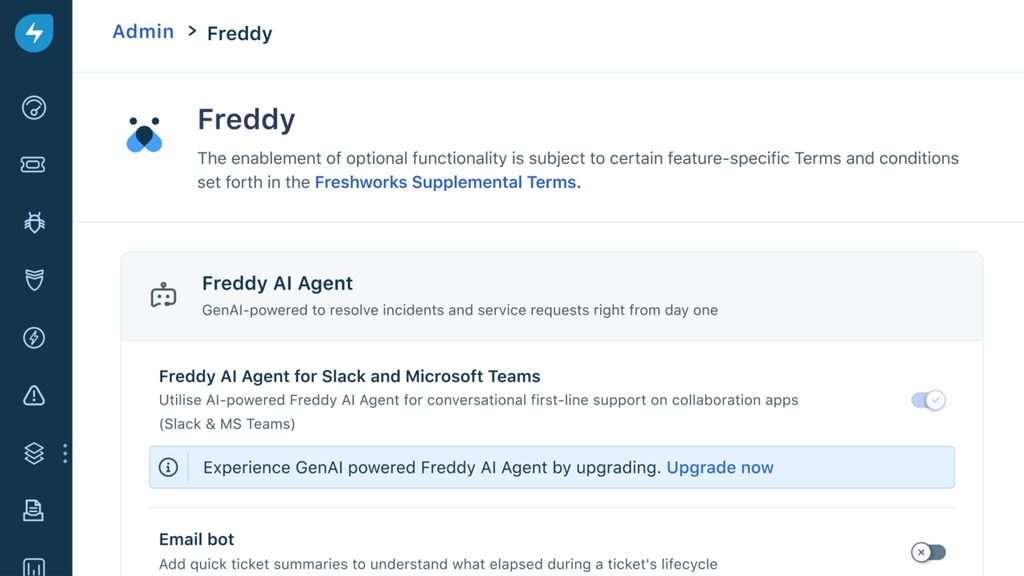
Freddy AI Agent (Classic) summarizes tickets and drafts agent responses for Enterprise plan subscribers with a complimentary 1,200 sessions per license per year. But the newer AI Agent Studio is free for Growth, Pro, and Enterprise plan subscribers until December 31, 2026. Freshworks claims it can go live in minutes with pre-built workflows and I found the basic features genuinely fast to turn on.
Other platforms to consider
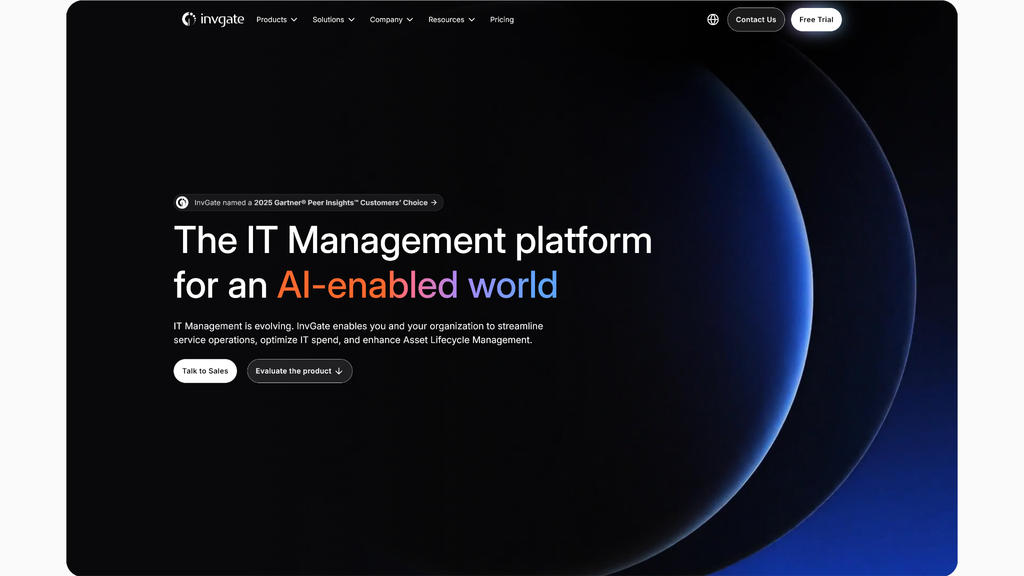
- InvGate: InvGate is a lean yet powerful enterprise-grade ITSM solution with an accessible entry point. Starting around $1,499/year for five agents, it’s great for teams that want strong ITIL alignment with cutting-edge AI features. If you go one tier up, the Pro plan costs $500 per agent per year for 5-50 agents, adding a workflow builder and AI Virtual Service Agent support for Teams and WhatsApp.
- Jira Service Management: JSM is a strong fit for teams that live in Atlassian tools. It’s free for up to three agents, with Standard around $20/agent/month and Premium near $51/agent/month for full incident management.
- Helix ITSM: As of October 2026, Helix has gone independent after being carved out of BMC. It’s built for regulated enterprises running hybrid infrastructure, with AI-driven operations management and Teams integration baked in. But it carries ServiceNow-level complexity and cost, so it’s a better fit for large organizations than for smaller IT teams.
- ManageEngine ServiceDesk Plus: A budget-conscious ITIL-ready option, with a free tier for up to five technicians. Best for cost-sensitive teams that still want certified ITIL process coverage without Freshservice’s per-agent pricing at scale.
- Zendesk: Originally built for customer support, Zendesk works well for centralizing your internal help desk with customer-facing support. Pricing starts near $29/agent/month for the Employee Service Suite, but climbs quickly at higher tiers.
FAQ
Is Freshservice cheaper than ServiceNow?
A 50-agent Freshservice deployment on the Pro plan runs roughly $60,000 a year. Meanwhile, third-party estimates put a comparable ServiceNow ITSM deployment between $500,000 and $2 million in year one after you factor in implementation costs.
Can Freshservice replace ServiceNow as a company grows past a few thousand employees?
Freshservice comfortably scales to a few thousand employees with all the standard ITIL features most teams need, including problem, change, and release management on its Pro tier.
But deep CMDB normalization or cross-departmental IT orchestration in a multi-cloud estate will reveal its cracks quickly. If your roadmap includes that kind of platform consolidation, you should plan for a platform migration down the line.
How long does a ServiceNow implementation take compared to Freshservice?
ServiceNow implementations can run anywhere between six to twelve months for a proper multi-module rollout through a certified implementation partner. Freshworks, by contrast, reports an average go-live of under 90 days. Personally, I found that simple configurations could go live in a single day.
Which of the two platforms has stronger AI features right now?
ServiceNow’s Now Assist is the more sophisticated option on paper, with predictive intelligence, autonomous AI agents, and Moveworks’ conversational layer now folded into the platform. But costs scale quickly as your usage grows, making it hard to justify for a smaller IT team that wants to take an AI-forward approach.
Freshservice’s Freddy AI is narrower in scope and offers limited self service through Slack or Teams. However, it’s faster to configure and free for Enterprise users up to 1,200 sessions per license. Smaller IT teams typically prefer predictability over sophistication for AI workloads.
Which platform is the better fit for an IT team without dedicated developers?
Freshservice is the better fit here, without a doubt. It has better no-code tooling, cheaper assistive AI, easier setup, and a much shorter implementation timeline. ServiceNow is more powerful, but any customization beyond out-of-the-box templates requires working with a certified developer or a paid implementation partner.